How The Litehouse replaced 3 scattered tools with one eCommerce OS
The Litehouse was growing, but its operations were split across Coda, Asana, and scattered documents. Product, marketing, supply chain, finance, and leadership all had pieces of the business, but no shared system to connect them. I designed and migrated the company into one Notion operating system built around visibility, handoffs, and daily execution.
The Litehouse
·
Ecommerce & Retail
·
Business OS Build
·
4 to 12 weeks
Notion
Asana
Coda
Published
·
updated
THE PROBLEM
The team was not missing effort, they were missing one source of truth. A department lived in one tool, the others lived in another, and documentation somewhere else. Each department had its own way of tracking work, which made it difficult for leadership to see what was moving, what was blocked, and what decisions had already been made. As the company scaled, the tool stack started creating extra coordination work instead of reducing it.
THE SOLUTION
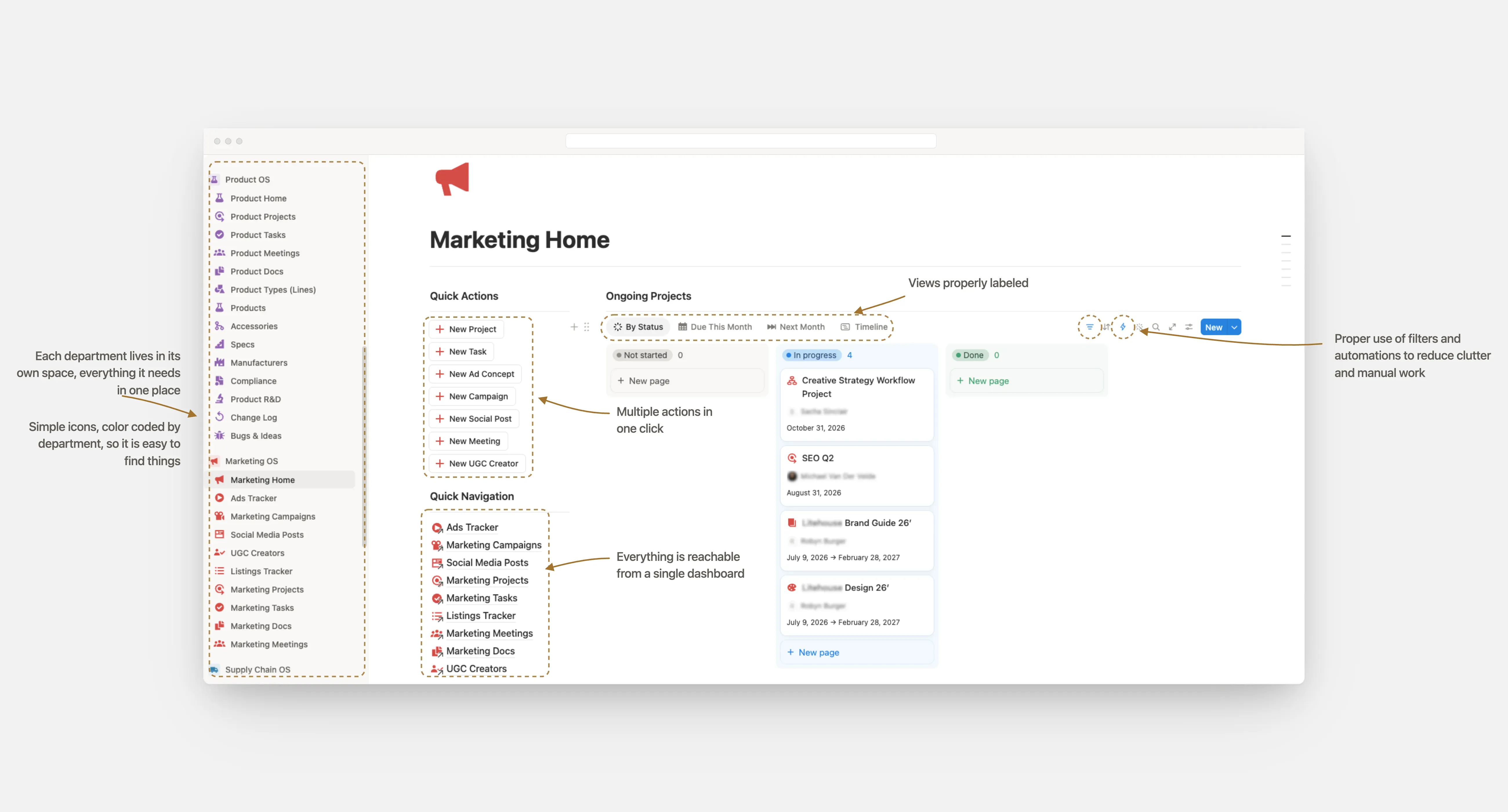
I built one connected Notion workspace to replace the siloed setup. At the center of the system are master Projects, Tasks, Documents, Meetings databases connected across departments. Around them, I created dedicated dashboards for Product, Marketing, Supply Chain, Finance, and leadership, so each team gets the view they need while still contributing to the same company-wide operating system. The workspace also includes an executive decisions hub, templates for repeatable workflows, Notion built-in Automations for tasks auto-generation, and a clean migration path from the old Coda and Asana setup into Notion.
THE PROCESS
I started with discovery sessions across departments to understand how work actually moved through the company. Then I translated the Coda and Asana setup into a Notion architecture, built the workspace in stages, migrated legacy information, and shared live demos with the teams. The final phase focused on QA, recorded tutorials, and live training, so the system could become part of daily operations instead of another tool people avoid.
THE RESULT
The Litehouse now runs its core operations from one connected workspace instead of three disconnected tools. Six departments can work inside the same system, while leadership gets real-time visibility into projects, decisions, and priorities across the business. The workspace is structured enough to bring clarity today, but flexible enough for the team to maintain and expand as the company grows.