

Published:
·
updated
9 min read
New 2026 data from 6,000+ workers reveals the AI adoption gap between leaders and employees, and why most companies are stuck. See the stats.

Every AI headline seems to come from one of two extremes: either every company has already “transformed,” or nobody has moved past ChatGPT for drafting emails. Neither is true, and the gap between them has a name now. Notion surveyed over 6,000 working professionals and AI decision makers across ten global markets in 2026, and what they found is a genuine AI adoption gap statistics can now put a number on: leaders and employees are describing two different companies.
If you’ve been staring at your own AI rollout wondering why it feels stalled while the C-suite keeps saying it’s “going great,” this data explains why. Here’s what the study actually found, and what it means if you’re trying to close that gap rather than just talk about it.
Get the full official Notion Report from here.
Most Companies Aren’t Behind on AI: They’re Just Stuck at the Start
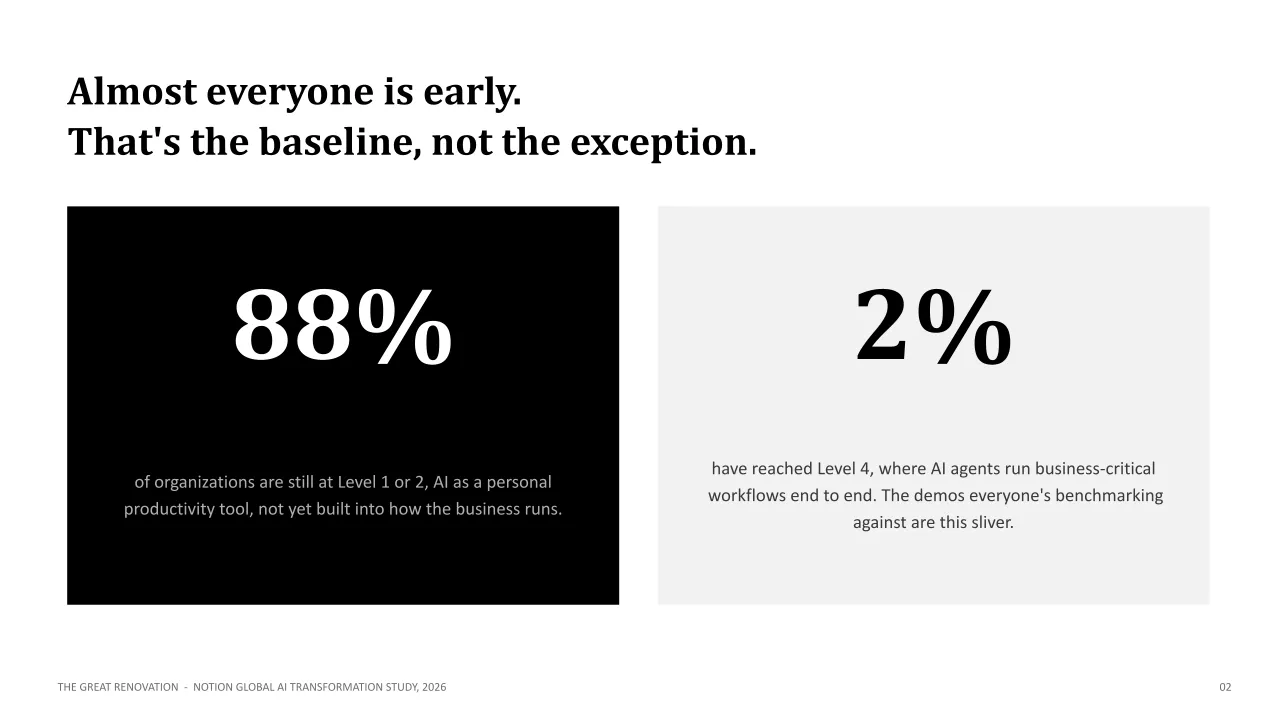
The headline number is scary: 88% of organizations are still at Level 1 or Level 2 of AI maturity, meaning employees use AI as a personal productivity tool, for drafting, summarizing, brainstorming, rather than something built into how the business actually runs. Only 2% have reached full “AI as the system” status, where agents run business-critical workflows end to end with real autonomy.
That 2% is worth sitting with, because it’s the group producing almost every viral AI case study, keynote demo, and “we replaced an entire department” headline currently in circulation. If you’re benchmarking your own progress against that discourse, it's worth noticing that you’re benchmarking against a tiny corner of reality, not the full picture.
The distribution the study found breaks down like this:
Level 1: AI as a thought partner (standalone tools for drafting and brainstorming): 57%
Level 2: AI as an assistant (embedded in daily work, with access to company context): 31%
Level 3: AI as teammates (agents automate recurring workflows end to end): 10%
Level 4: AI as the system (agents run complex, business-critical processes autonomously): 2%
Early is the baseline. Not the exception.
The AI Adoption Gap Between Leaders and Employees, By the Numbers
This finding should not be underestimated. Decision makers and the employees actually using AI day-to-day aren’t just slightly out of sync, they’re describing organizations that barely resemble each other.
60% of AI decision makers say their organization is ready to deploy AI agents. Only 36% of AI users agree.
49% of decision makers say they’re confident in their organization’s ability to use AI effectively. Only 23% of AI users say the same.
Overall, decision makers are 5x more likely than their own employees to say the company has reached an advanced stage of AI transformation.
If you think about it, that’s not a number error, and it’s not a communication problem you fix with a webinar. It’s an execution risk. AI transformation isn’t driven by executive ambition alone, it only becomes real when the people doing the work have the clarity, confidence, and tools to actually change how work gets done. If you only survey leadership before making a rollout decision, you’ll get an answer, just not the right one, and any decision that follows will not solve the underlying problem.
Why Employees Don’t Trust, or Even See, the AI Their Company Uses
Underneath the perception gap are two more specific, more fixable problems: trust and visibility.
71% of AI users say they’d use AI more if they trusted it not to make mistakes on important work. That number holds steady no matter how mature the organization is, readiness doesn’t solve trust on its own, it has to be designed for. As one UK respondent in the finance and HR space put it: “The time saved on creation is just used up checking the output.”
On the other side, 50% of AI decision makers say employees are using unapproved AI tools, or admit outright that they don’t know which tools their people are actually using. This isn’t a minority-of-companies problem; it’s a coin flip. One US respondent described it bluntly: “It’s pretty much wild west, nobody is really regulating or restricting what we use.”
Trust and visibility are the same problem seen from two sides. If employees don’t trust the output, they won’t rely on it. If leaders can’t see how AI is actually being used, they can’t fix what’s broken or scale what’s working.
The Hardest Jump in AI Adoption Isn’t Getting Started
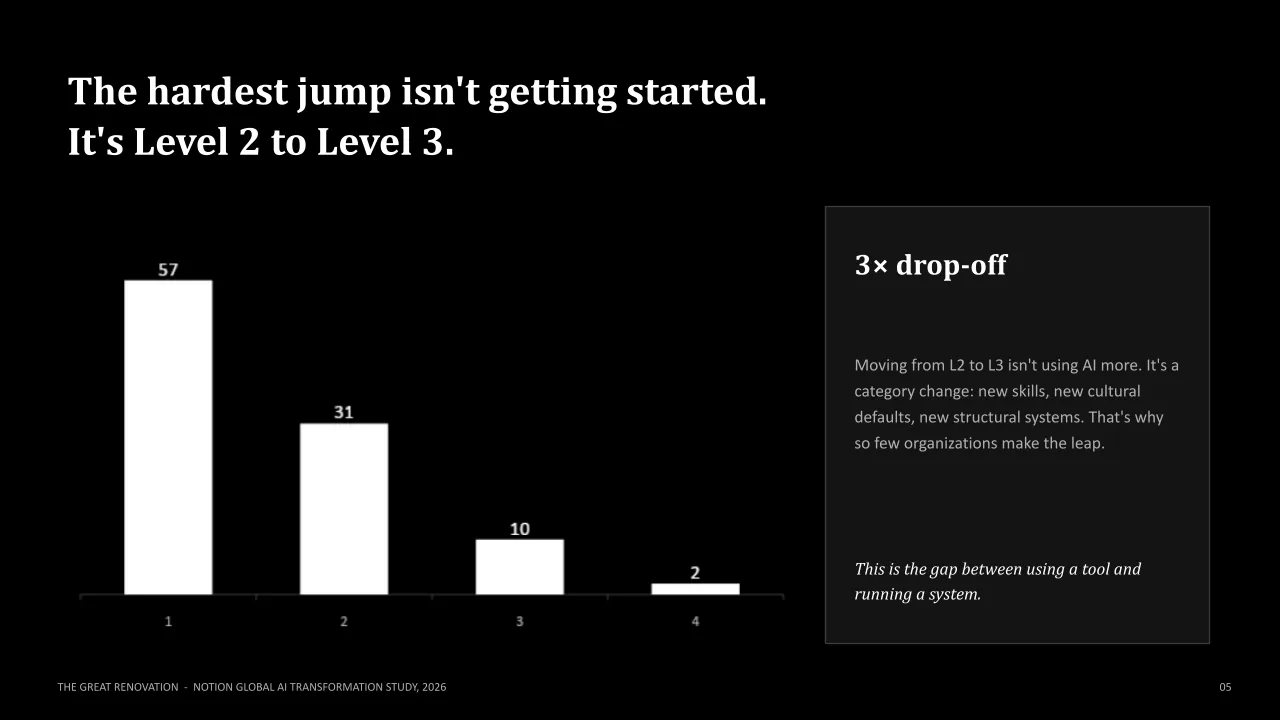
Look again at that maturity breakdown: 57%, 31%, 10%, 2% and the steepest drop is the fall from Level 2 (31%) to Level 3 (10%), a roughly 3x cliff.
That’s the most important shape in the entire dataset, because it tells you what’s actually hard about AI transformation. Moving from Level 1 to Level 2 is mostly about adoption; more people using more tools, more often. Moving from Level 2 to Level 3 is a category change: new skills, new cultural defaults, new structural systems for how work gets routed and reviewed. That’s a much bigger lift than “use AI more,” which is exactly why so few organizations make the leap, and why the ones stuck at Level 2 often feel like they’re doing everything right and still not moving.
What Separates the Companies That Actually Get There
Notion asked AI decision makers which of eight implementation strategies their organization had in place, across everything from training programs to governance frameworks. Most of them, training, written policies, standardized tools, didn’t meaningfully separate mature organizations from early-stage ones, because nearly everyone already invests in them.
Three did, and the gaps were nearly twice the size of anything else measured:
Integrating AI into existing systems: +18 percentage points more common at Level 3–4 organizations than Level 1–2 ones (55% vs. 37%)
Building governance and oversight: +16 percentage points (42% vs. 26%)
Measuring AI’s impact with defined metrics: +15 percentage points (37% vs. 22%)
In other words: training and policy get an organization off the ground, but they get blocked quickly. The moves that compound are the ones that wire AI into the systems and rules already running the business, not the ones that hand people another tool and a slide about responsible use.
The New Problems That Show Up Once You’re “Doing AI Right”
Now, you'd think the grass is greener on the side of companies at Level 3-4, but that's not true. Getting more mature doesn’t make the challenges disappear. It changes their shape entirely.
The human-facing barriers genuinely get easier at the most advanced organizations. Low trust in AI outputs as a cited barrier drops 8 percentage points, and skills or training gaps drop 3 points. Enablement and change management work does pay off.
But the structural problems get sharply worse. Tool sprawl: too many overlapping AI tools in use, more than doubles, up 14 percentage points. Difficulty seeing AI’s real impact rises 9 points. Inconsistent model performance rises 5 points. And a few problems, like unclear governance and poor integration between tools, simply hold steady at every stage, they don’t resolve themselves with time.
The pattern is evident: the early stage of AI transformation is about helping people use AI. The later stage is about controlling the sprawling system it becomes: fewer disconnected tools, one place where the work actually lives, and impact you can actually see and measure. This is why we specialize in turning Notion into your business single source of truth.
Closing the Gap
None of this data is really about AI. It’s about systems. The organizations pulling ahead aren’t the ones with the fanciest AI programs, they’re the ones who did the less glamorous work of integrating AI into what already exists, putting real governance around it, and measuring outcomes instead of vibes.
That’s the exact gap we fill inside at The Digicrafters: closing the space between “our team uses AI tools” and “AI is wired into how our team actually works,” inside the systems - Notion and beyond - that a company already runs on. Not another chatbot license, but actually the system underneath it.
If your own numbers would look more like the 36% than the 60% in that leader-worker gap above, that’s the normal situation everyone else is quietly stuck in too. And we're here to help make it easier to overcome.
All content in this article is grounded in real customer interactions and real projects we’ve worked on, the analysis, insights, and ideas are entirely my own. AI tools may have been used to help process raw data, or to reformulate and refine parts of the writing.
Related articles
Frequently asked questions
What percentage of companies have fully adopted AI at work in 2026?
According to Notion’s 2026 Global AI Transformation Study of 6,000+ professionals, only 2% of organizations have reached the most advanced maturity level, where AI agents run business-critical workflows autonomously. 88% remain at the earliest two stages, where AI is used mainly as a personal productivity tool.
Why is there such a large AI adoption gap between leaders and employees?
The Notion study found decision makers are 5x more likely than employees to say their organization has reached an advanced stage of AI transformation. The gap comes down to two compounding issues: employees don’t fully trust AI outputs on important work, and leaders often lack visibility into which AI tools employees are actually using.
What’s the hardest stage of AI transformation to get through?
Data shows the steepest drop-off is between Level 2 (AI embedded in daily tools) and Level 3 (AI automating recurring workflows), a roughly 3x decline. Unlike earlier stages, this jump requires structural change, new skills, oversight, and systems, not just broader tool usage.